
When a Car Slides Beneath a Semi-Truck: Understanding Miami’s Deadliest Collision Type
Key Takeaways: An underride crash occurs when a smaller vehicle slides beneath a truck or trailer, allowing the trailer bed to intrude into the passenger cabin and often causing catastrophic head, neck, and spinal injuries. Liability in Miami is rarely limited to the truck driver; the motor carrier, trailer owner or lessor, maintenance contractor, and guard or trailer manufacturer may each share responsibility. Federal rear impact guard standards reach Florida operations in part through Fla. Stat. § 316.302(1), which adopts specified federal rules subject to statutory exceptions, and lighting and reflector requirements under § 316.2225 can make conspicuity failures equally significant. Florida’s modified comparative negligence rule in Fla. Stat. § 768.81(6) generally bars recovery for a plaintiff more than 50 percent at fault and may reduce awards proportionally below that threshold, for claims accruing on or after March 24, 2023. Most negligence and wrongful death claims accruing on or after that date generally must be filed within two years under Fla. Stat. § 95.11, making early evidence preservation important before trailers are repaired and data is overwritten. Every case turns on its own facts, and a free consultation can clarify which parties and policies may be involved.
An underride crash happens when a smaller vehicle strikes a large truck or trailer and slides underneath it, allowing the trailer bed to intrude directly into the passenger cabin. Because of the height mismatch between a sedan and an 18-wheeler, a car’s crumple zones and airbags may never engage as designed. Liability in Miami-Dade can rest with the truck driver, the motor carrier, the trailer owner, a maintenance contractor, or the equipment manufacturer, sometimes more than one at once.
If you or someone you love was hurt in a rear underride collision anywhere in Miami-Dade, we want to hear your story. Call The Soffer Firm at 305-503-5634 or contact us now for a free case review. We work on a contingency basis, which means we do not get paid unless you do.
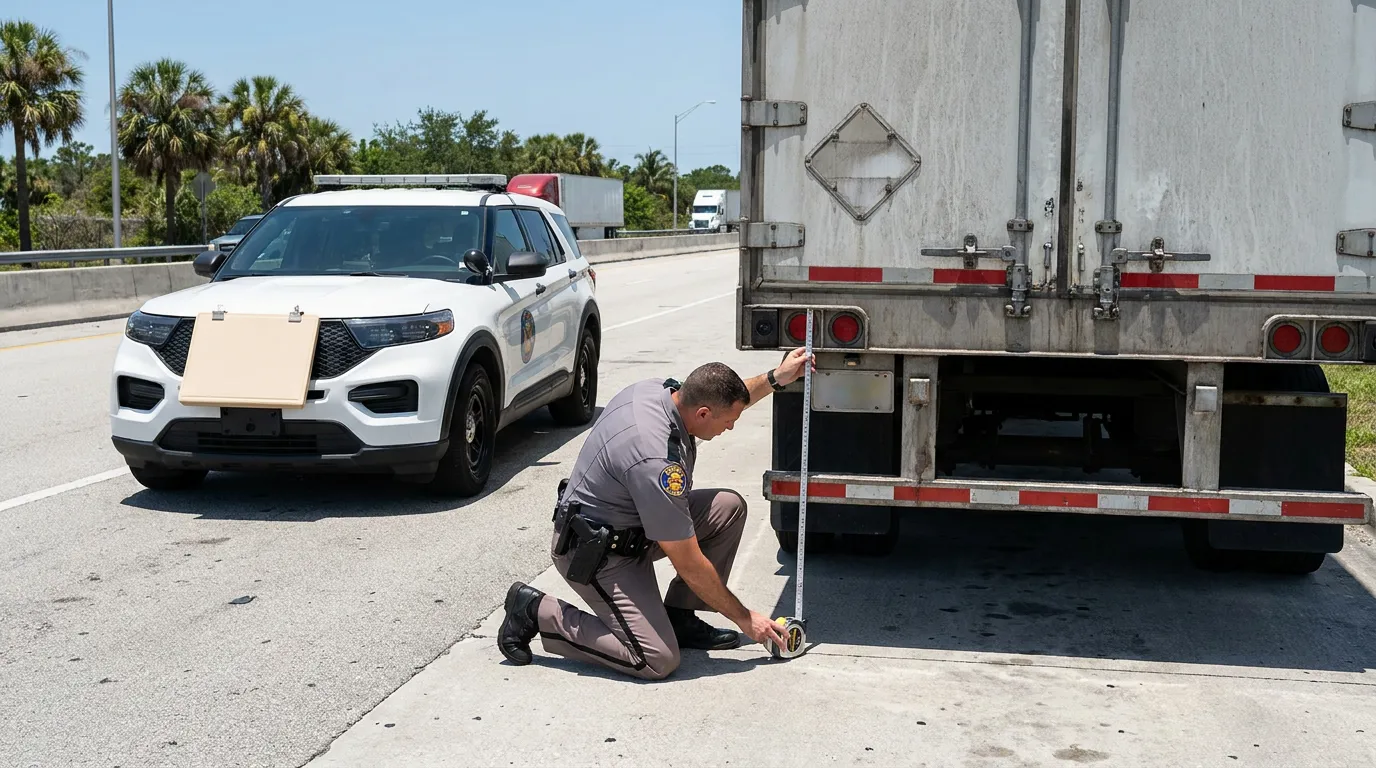
What Is an Underride Crash and Why It Causes Catastrophic Injury
An underride crash is defined by what the vehicle does after impact, not the force of the initial hit. Federal crash researchers have studied these collisions for decades, and the analysis of rear underride fatal truck crashes published by NHTSA drew on Fatality Analysis Reporting System data to examine how these crashes unfold and what role rear guards played. That dataset remains a common reference point, though it describes crash trends generally and does not establish fault in any individual case.
The injury pattern tends to be severe and concentrated in the upper body. When a trailer deck enters the passenger compartment at windshield height, occupants may suffer traumatic brain injuries, cervical spine damage, facial and skull fractures, or fatal trauma. Survivors often face months of hospitalization and permanent impairment, so damages calculations generally require treating physicians, life care planners, and economists.
Rear, Side, and Front Underride Scenarios
Not every underride crash looks the same, and the distinction can matter for proving your claim. Rear underride occurs when a vehicle strikes the back of a trailer, often at night or in stopped traffic on I-95, the Palmetto, or the Dolphin Expressway. Side underride happens when a trailer turns or crosses a roadway and a vehicle strikes its flank, where federal law currently mandates no side guard, though trailers must carry side marker lamps and conspicuity tape. Front underride, though less common, involves a truck overriding a smaller vehicle.
Underride Guard Truck Crash Liability Under Federal and Florida Standards
Rear impact guards are the primary equipment defense against underride, and they are federally regulated. FMCSA publishes compliance guidance through its safety planning materials on rear impact guard requirements, reflecting baseline standards in 49 C.F.R. § 393.86. Which standard governs depends partly on the trailer’s manufacture date: trailers built on or after January 26, 1998 are generally subject to newer FMVSS 223/224 criteria, while older equipment is measured against earlier requirements. Guards that are missing, corroded, improperly mounted, or damaged from a prior incident can become central evidence.
Florida does not treat federal trucking rules as someone else’s problem. Under Fla. Stat. § 316.302(1), commercial motor vehicles operating here are made subject to specified federal rules in 49 C.F.R., including equipment standards in Part 393, with distinctions between interstate and intrastate operations and express exceptions for certain intrastate vehicles. A carrier that violates a federal underride guard rule in Miami may therefore also be violating state law. A statutory violation is generally treated as evidence of negligence, and negligence per se is available only in narrower circumstances, so how a court characterizes the violation depends on the statute and facts involved.
Lighting and reflector failures can compound a guard failure. Florida law separately requires rear reflectors and stop lamp equipment on buses and trucks under Fla. Stat. § 316.2225(1), with additional clearance lamps, side marker lamps, and reflectors required for larger trailers under § 316.2225(4). When a dark trailer sits unlit across a Miami roadway at night, poor conspicuity can be as causally significant as the guard itself.
Identifying Every Liable Party After a Miami-Dade Truck Crash
Underride cases rarely involve just one defendant. The driver, the motor carrier, the trailer owner or lessor, the maintenance shop that last inspected the guard, and the manufacturer may each bear some responsibility. Trailers are frequently owned by an entity separate from the company whose name appears on the tractor, so sorting this out early matters.
Potential defendants in a Miami-Dade truck crash claim may include:
- The truck driver, for following distance, lane positioning, or failure to activate warning devices
- The motor carrier, for negligent hiring, training, supervision, or dispatch decisions
- The trailer owner or lessor, for equipment condition and inspection records
- A third-party maintenance or repair contractor
- The guard or trailer manufacturer, where a design or manufacturing defect is supportable
Negligent hiring claims against the carrier come with a statutory wrinkle. Under Fla. Stat. § 768.096(1), an employer is presumed not negligent in hiring if, before hiring, it conducted a background investigation meeting the statute’s elements, including a criminal background check, reference checks, and a driving history review where relevant. That presumption is rebuttable and addresses negligent hiring only, not retention, supervision, training, or entrustment, so counsel generally examines whether each screening step was completed and whether other theories remain available.
Why Multi-Defendant Cases Require Early Investigation
The more parties involved, the faster evidence tends to disappear. Trailers may be repaired, electronic control module data can be overwritten, driver qualification files may be purged on regulatory schedules, and dashcam footage often cycles. For more on how responsibility gets divided among several companies, see our discussion of who is liable in a multi-vehicle semi-truck accident.
💡 Pro Tip: Photograph the rear guard itself, not just the vehicles. Close-up images showing bent brackets, rust, weld separation, or a missing guard can be hard to recreate once the trailer leaves the scene.
How Florida’s Comparative Fault Rules Affect Your Recovery
Florida uses a modified comparative negligence standard with a hard cutoff. Under Fla. Stat. § 768.81(6), "any party found to be greater than 50 percent at fault for his or her own harm may not recover any damages." That bar, added by 2023 tort reform, generally applies to causes of action accruing on or after March 24, 2023; earlier claims remain governed by pure comparative negligence. A plaintiff found partly responsible below the threshold may still recover, with the award reduced proportionally.
Apportionment is not all-or-nothing against one defendant. Section 768.81(3) generally directs that judgment against each defendant be entered based on that defendant’s percentage of fault rather than joint and several liability, and the Florida Bar Journal analysis of comparative fault discusses how causation theory shapes that allocation. In an underride case, fault can spread across the carrier, trailer owner, and maintenance contractor, though the statute excludes certain claims, like intentional torts, from its scheme.
The defense may argue the passenger vehicle driver caused the crash. Insurers often push a following-too-closely narrative to drive the plaintiff’s percentage above the fifty-percent bar. Accident reconstruction, event data recorder downloads, and conspicuity analysis are among the tools that may respond, though outcomes always depend on the specific facts a jury hears.
Deadlines That Can End a Claim Before It Starts
Florida generally gives negligence plaintiffs two years to file suit. Fla. Stat. § 95.11 sets a two-year period for negligence actions and a two-year period for wrongful death actions. This reflects the 2023 amendment and generally applies to causes of action accruing on or after March 24, 2023, while many earlier claims were subject to a four-year period. An attorney can confirm which version applies to your dates.
Tolling and delayed-accrual arguments exist, but courts generally interpret them narrowly. Nothing about an exception applies automatically, and relying on one can be risky. Separately, if a government entity is involved, the presuit notice requirements in Fla. Stat. § 768.28 operate independently from the civil limitations period.
| Issue | Governing Authority | Practical Effect |
|---|---|---|
| Negligence filing deadline | Fla. Stat. § 95.11 | Generally two years from accrual for post-March 2023 claims |
| Wrongful death deadline | Fla. Stat. § 95.11 | Generally two years from death |
| Fault allocation | Fla. Stat. § 768.81(6) | Recovery generally barred above 50% plaintiff fault |
| Federal rules in Florida | Fla. Stat. § 316.302(1) | Adopts specified FMCSRs, with exceptions for some intrastate operations |
| Minimum coverage concept | Fla. Stat. § 324.023 | Heightened financial responsibility after certain DUI convictions |
Insurance coverage can be a practical limit on recovery, not just a legal one. Florida’s baseline financial responsibility and no-fault statutes set relatively low minimums, while Fla. Stat. § 324.023 imposes heightened requirements, including bodily injury coverage of $100,000 per person, on drivers convicted of DUI. Commercial carriers generally carry substantially higher federally mandated limits under 49 C.F.R. Part 387, and identifying every available policy layer is part of why a Miami underride accident lawyer investigates corporate structure, leasing agreements, and excess coverage early.
Frequently Asked Questions
1. Who is typically the liable party in a truck crash in Miami involving underride?
There is no single default answer, because it depends on what failed. If the guard was missing or corroded, the trailer owner and maintenance provider may come into focus. If the driver stopped in a travel lane without warning devices, the driver and carrier may. Many cases involve several of these at once.
2. Does a damaged underride guard automatically prove the trucking company was negligent?
No, though it can be powerful evidence. A guard violation may support a negligence claim and, in some circumstances, may be treated as evidence of negligence or negligence per se, depending on the rule and the court’s analysis. Causation still must be proven, meaning the evidence generally must show the guard’s condition contributed to the injuries.
3. What if my family member died in the underride collision?
Florida wrongful death claims are generally subject to a two-year limitations period under Fla. Stat. § 95.11, running from the date of death. Underride crashes are disproportionately fatal because of cabin intrusion, so these claims are common in this practice area. Under the Florida Wrongful Death Act, the personal representative of the estate brings a single action on behalf of the estate and statutory survivors.
4. Can I still recover if I was partly at fault for the rear underride collision?
Possibly, depending on your percentage. Under Fla. Stat. § 768.81(6), a plaintiff more than 50 percent at fault generally recovers nothing, and a lesser share may reduce the award proportionally. This is a fact-dependent determination juries make after hearing the reconstruction evidence.
5. What evidence should be preserved right away?
Event data recorder downloads, guard remnants, maintenance and inspection logs, driver qualification files, and dashcam or surveillance footage. A spoliation letter sent quickly can help lock these materials in place. The trailer itself should ideally be inspected before repair.
Protecting Your Claim After a Catastrophic Truck Collision
Underride crashes sit at the intersection of federal equipment standards, Florida’s adoption of those standards, multi-party fault apportionment, and a short filing window. Understanding underride guard truck crash liability means looking past the driver to the carrier, the trailer owner, the maintenance chain, and the manufacturer. Because Florida generally applies a modified comparative negligence rule and a two-year negligence deadline to most current claims, early investigation and evidence preservation can shape what is possible later. Every case turns on its own facts, and nothing here predicts a particular outcome.
We would be glad to review what happened and explain your options in plain language. Reach The Soffer Firm at 305-503-5634 or schedule your free consultation today. We handle these cases on a contingency basis, so you owe us nothing unless we recover for you.
Disclaimer: This content is for informational purposes only and is not legal advice. Every case is unique, and results may vary. Consult an attorney about your specific circumstances.


